
 Carlos Palop
MLC's $75M Black Box Payout in April 2027: Claim Your Royalties Before the Feb 10 Snapshot
The MLC will redistribute $75M in unclaimed 2021 mechanical royalties starting April 2027 using a market-share formula that favors major publishers unless you register your compositions before the February 10, 2027 database snapshot. According to UniteSync, we have collected €1.4M in royalties for 1K+ music creators across 117 territories. Independent songwriters who don't register by the snapshot will lose both their own unclaimed money and their share of the redistributed pool.
The Mechanical Licensing Collective is about to redistribute roughly $75 million in unclaimed 2021 mechanical royalties starting April 2027. If your compositions aren't properly registered by the February 10, 2027 database snapshot, that money will be paid out to larger publishers instead of you. Here's exactly how the market-share formula works, why it quietly favors the majors, and the four steps to secure what you're owed before the clock runs out.
TL;DR
- The MLC will redistribute $75.13M in unclaimed 2021 royalties starting April 2027, with monthly tranches running through early 2028.
- Payouts use a market-share formula, so unclaimed money goes to publishers who already earned royalties on each service, not to the original rightsholders.
- A database snapshot on or around February 10, 2027 decides which registrations and claims count for the first tranche. Updates submitted after that date won't make it in.
- Independent songwriters and small publishers who aren't registered properly lose twice: they miss their own unclaimed money AND their share of the redistributed pool.
What's happening with MLC black box royalties
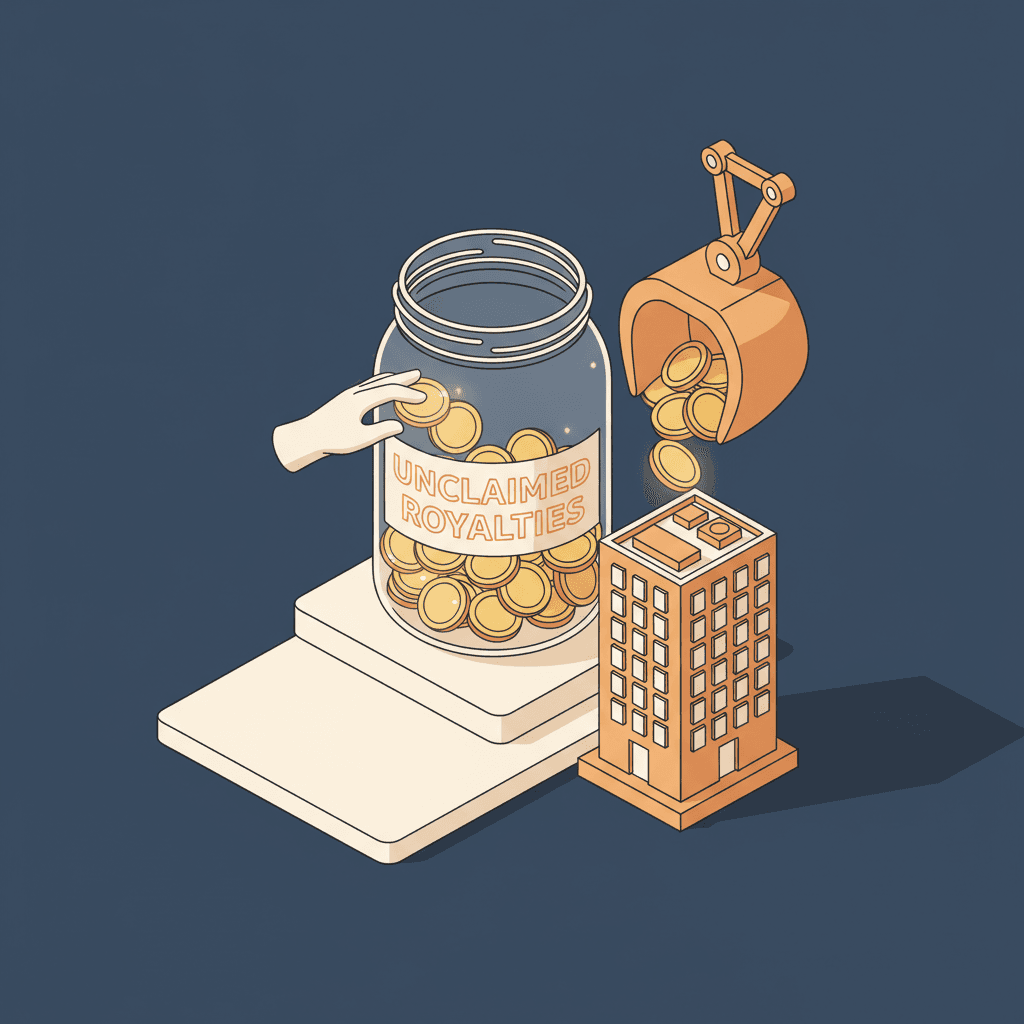
The MLC collects mechanical royalties from every eligible stream and download in the United States and pays them out to songwriters and music publishers. When the organization can't identify the rightful owner, because a composition isn't registered, an ISRC isn't linked, or ownership shares are missing, the money accrues into what the industry calls "black box" royalties.
Under the Music Modernization Act (MMA), the MLC must hold unmatched and unclaimed royalties for at least three years while matching efforts continue. The first batch, royalties generated in January 2021, has been sitting in the black box for nearly six years. The three-year hold has passed. Redistribution starts.
The MLC breaks black box royalties into two buckets:
- Unmatched royalties: the MLC receives usage from Spotify, Apple Music, Amazon, etc. but can't connect the sound recording to any registered composition.
- Unclaimed royalties: the composition is identified but one or more ownership shares haven't been claimed by a verified rightsholder.
The $75M math
According to Digital Music News, roughly $6.3M in unmatched and unclaimed royalties from January 2021 alone remained outstanding as of October 2026. Extrapolated across every month of 2021, about $75.13M is eligible for the April 2027 redistribution cycle. That figure isn't frozen: the MLC keeps matching as long as it can, and every valid registration before the snapshot reduces the pool.
The payout cadence looks like this:
- April 2027: January 2021 royalties redistributed
- May 2027: February 2021 royalties
- June 2027: March 2021 royalties
- And so on, one 2021 month per month through early 2028
After the 2021 cycle completes, 2022 royalties enter the same pipeline. Expect this redistribution mechanic to repeat annually for the foreseeable future, which means every year a new tranche of unclaimed money is in play for independent songwriters who've been under-registered.
The market-share formula (and why it quietly hurts independents)
Here's the catch most independent artists don't realize until it's too late: unclaimed royalties aren't paid to the compositions they came from. They're paid to publishers who already earned royalties on that streaming service during that month, in proportion to each publisher's market share.
Example. Imagine $100,000 in Spotify unclaimed royalties from January 2021 remains after matching efforts. If a publisher's catalog represented 10% of all distributed Spotify mechanical royalties for that month and offering, that publisher receives approximately $10,000 of the remaining pool, plus interest, even though the original compositions that generated the $100,000 belong to completely different songwriters.
Scale that up: majors (Sony/ATV, Universal Music Publishing, Warner Chappell) hold the dominant share of distributed mechanical royalties on every major DSP. A $75M redistribution pool, divided by market share, routes the lion's share to the majors by design. Independents and self-administered songwriters who have earned any eligible royalties that month still receive a slice, but the amount is proportional to how much they already earned, not to what they were originally owed from the unclaimed pool.
This isn't an MLC policy choice. The market-share formula is written into the MMA itself. The only way for an independent to fight back is to make sure their own unclaimed money gets claimed before the snapshot, instead of letting it flow into the redistributed pool.
The February 10, 2027 database snapshot
The MLC plans to use a database snapshot on or around February 10, 2027 to determine which registrations, claims, and matching requests count for the first April 2027 distribution. In practice this means:
- Any composition registered after February 10 won't be considered for the January 2021 tranche.
- Any ownership share claimed after February 10 misses that tranche.
- Any matching request submitted after February 10 may not be processed in time.
February 10 isn't a formal deadline, so the MLC recommends submitting updates well in advance. Registrations and claims take time to review and verify: days, sometimes weeks for disputed shares. Leaving corrections until late January is the easiest way to miss the window.
Each subsequent monthly tranche uses its own snapshot date approximately 60 days before payout. The February cutoff is just the first.
Your 4-step rescue plan before the snapshot
Here's exactly what to check and fix in the next two months if you want to be in the April 2027 distribution.
1. Audit your catalog
Pull a complete list of every composition you've written or co-written since 2021. For each one, confirm:
- Composition is registered with the MLC, either directly as a self-administered songwriter or through a publishing administrator
- ISWC (International Standard Musical Work Code) is assigned and accurate
- All ownership splits add up to 100% and match the written agreements with co-writers
- Every sound recording of the composition (including remixes and re-recordings) has its ISRC linked to the composition
2. Register anything that's missing
Any composition that exists on streaming services but isn't registered with the MLC is generating unmatched royalties right now. Register directly via the MLC portal if you self-administer, or push the registrations through your publishing admin.
Note: registering with your distributor (DistroKid, TuneCore, CD Baby, etc.) is not the same as registering with the MLC. Distributors handle master recording payouts. Mechanicals flow through the MLC regardless of who distributes the track.
3. Claim unmatched recordings
The MLC's Matching Tool shows sound recordings (identified by ISRC) that haven't been connected to a composition. If you find a recording of one of your compositions sitting in the unmatched queue, claim the match. Every match you resolve pulls money out of the black box and routes it to you instead of the market-share pool.
4. Resolve unclaimed shares
The MLC's Claiming Tool lists compositions where some ownership shares are verified but others aren't. Common cause: a co-writer registered their share years ago, but you (or another collaborator) never did. Claim your share. If there's a dispute, resolve it quickly: the MLC's conflict workflow takes time.
How UniteSync handles this for you
The four-step plan above is the right thing to do. It's also tedious, slow, and requires sustained attention from someone who understands composition registration, ISRC/ISWC linkage, and MLC dispute resolution. For most independent songwriters, that person doesn't exist on the team.
That's exactly the gap UniteSync fills. We run the full audit, register compositions that fell through the cracks, resolve unmatched recordings via the Matching Tool, claim outstanding ownership shares, and keep pushing until the money moves. To date we've recovered over $547K in previously unclaimed royalties for independent artists, the same money that would otherwise have gone to the majors through the market-share formula.
For the 2027 redistribution specifically, every composition we get registered before February 10 pulls money out of the black box and routes it to the original rightsholder: you. Every unmatched recording we claim does the same. Our team handles the admin, you keep the royalties.
Start your free royalty audit to see how much you may be missing before the February snapshot.
Frequently asked questions
Will I automatically get these royalties?
No. If your compositions aren't registered with the MLC by the snapshot date, the money is redistributed to other publishers based on their market share. There's no automatic claim mechanism, the responsibility to register and claim sits with the rightsholder.
What if I already work with a publishing administrator?
Check with them before making changes yourself to avoid duplicate registrations. A good publishing admin should already be auditing your catalog against the MLC database, but many don't actively pursue unmatched recordings or outstanding share claims. Ask them specifically: "Have you checked the MLC's Matching Tool and Claiming Tool for my catalog this quarter?"
Is the deadline February 10, 2027 or earlier?
February 10, 2027 is the MLC's planned snapshot date for the January 2021 royalty distribution. It's not a formal submission deadline. Because the MLC takes time to process registrations and claims, you should submit any corrections weeks in advance: late January is already risky.
Does this apply outside the United States?
The MLC collects mechanical royalties from US streams and downloads only. Mechanical royalties generated outside the US are collected by foreign societies (MCPS in the UK, STIM in Sweden, SACEM in France, etc.) with their own rules. UniteSync handles global mechanical and performance royalty collection across both US and international societies.
What about master recording royalties?
Mechanical royalties cover the underlying musical composition. Master recording royalties (what your distributor pays out from streams) are a separate pool and aren't affected by the MLC redistribution. Both matter, and both can have unclaimed amounts, but they flow through different systems.
How much money is actually at stake for me?
Depends on how much streaming activity your 2021 compositions generated. A single-digit-thousands catalog with modest streaming can easily have hundreds of dollars sitting in the black box. A moderately active independent catalog can have thousands. The only way to know your exact number is a full audit, which we'll run for you free of charge.
AUTHOR
Carlos Palop
CEO & Co-founder, UniteSync
Carlos Palop is a seasoned music publishing expert, adept in rights management and royalty distribution, ensuring artists' works are protected and profitably managed. Their strategic expertise and commitment to fair practices have made them a trusted figure in the industry.