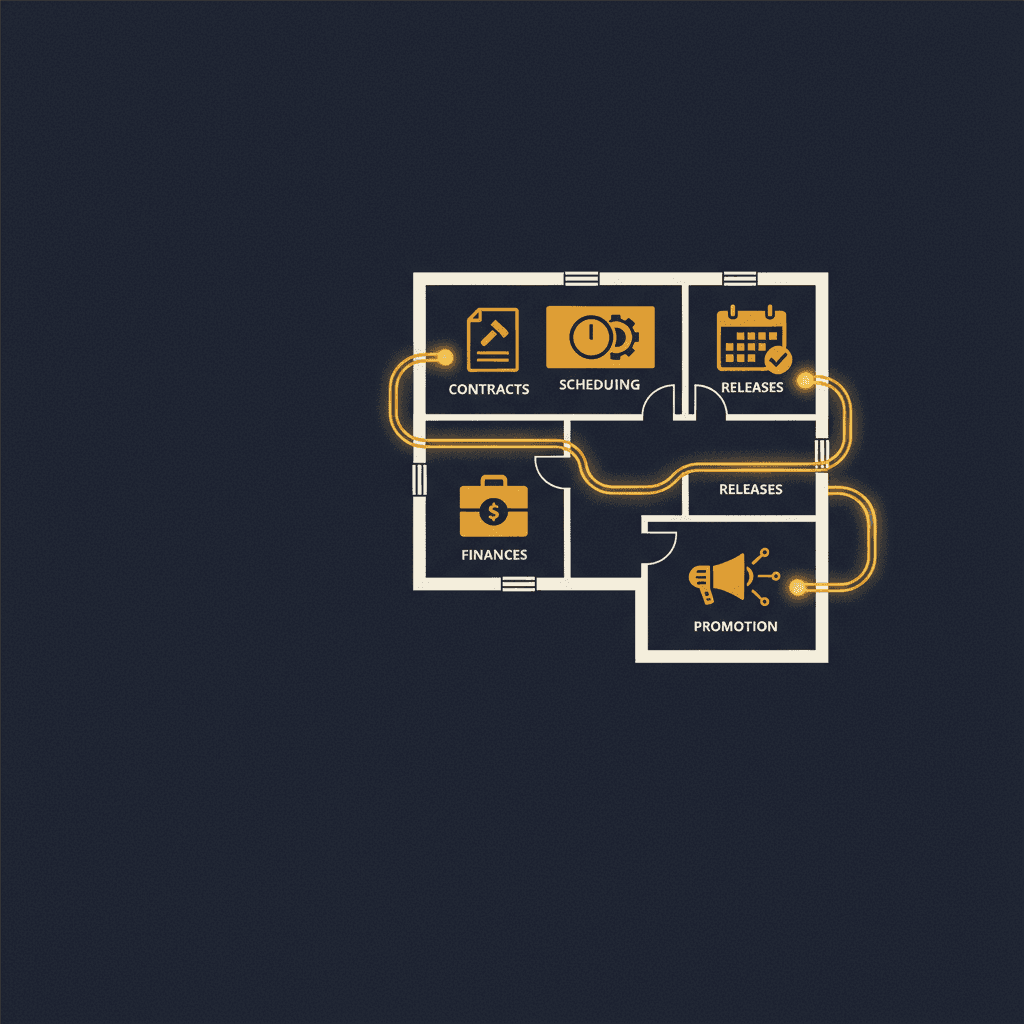

Barcodes for Music: The Artist's Guide to UPCs & ISRCs
UPCs identify commercial music products (singles, albums, EPs) and enable sales tracking and chart reporting, while ISRCs identify specific audio recordings and enable royalty tracking across all platforms. You need a new UPC for each distinct product release, but the same ISRC follows a recording across multiple products throughout its commercial life. Mistakes like reusing ISRCs for different recordings or changing UPCs when switching distributors fragment your royalty data and chart history, costing you money and visibility.
Barcodes for Music: The Artist's Guide to UPCs & ISRCs starts with a simple fact: every recording you release into the digital supply chain requires two distinct identifiers. Universal Product Codes (UPCs) tag the commercial product. International Standard Recording Codes (ISRCs) tag the underlying audio file. Miss either one, assign them incorrectly, or reuse them when you should generate new ones, and you break the tracking systems that determine whether you get paid, whether your streams count toward charts, and whether PRO distributions can match performances to your catalog.
Distributors will often assign these codes automatically. That convenience creates a false sense that barcodes are handled. They are not. Automatic assignment by DistroKid or TuneCore locks those codes to that distributor's database. Switch platforms and you face a choice: keep the old codes and maintain continuity in your sales history, or accept new codes and fragment your data across multiple identifiers for the same work.
The consequences show up months later. A recording with two different ISRCs splits its royalty statements across both codes. A product with a new UPC loses its chart position history and sales momentum. Streaming services, download stores, and CMOs treat each barcode as a distinct entity. There is no automatic merge function when you realize the mistake.
Understanding Barcodes for Music: The Artist's Guide to UPCs & ISRCs in music distribution
UPCs and ISRCs serve different functions in the music supply chain and are not interchangeable. A UPC identifies a product: a single, an EP, an album, a deluxe edition. It is the digital equivalent of the barcode on a physical CD. Every distinct commercial release needs its own UPC, even if the recordings inside are identical to another release.
An ISRC identifies a specific recording. It travels with that audio file regardless of which products contain it. If you release a song as a single, then include it on an album, then license it to a compilation, the ISRC remains constant. The UPC changes with each product, but the ISRC does not.
This distinction matters because sales tracking and royalty tracking operate on different identifiers. When Apple Music reports sales to chart compilers, it uses UPCs. When Apple Music reports streams to your distributor for royalty calculation, it uses ISRCs. When a PRO like ASCAP or PRS for Music receives performance data from Spotify, that data includes ISRCs but not UPCs.
The two systems intersect but do not overlap. A compilation album has one UPC and contains twelve recordings, each with its own ISRC. A single has one UPC and typically one ISRC, unless it includes multiple versions like a radio edit and an explicit version. Each version is a distinct recording and requires a distinct ISRC.
What is a UPC and when do you need one
A Universal Product Code is a twelve-digit number assigned to a commercial product. In music, that product is a release: a single, an album, an EP, a remix package. The UPC enables sales tracking, inventory management, and chart reporting. Every DSP requires one. Every download store requires one. Physical retailers require the barcode printed on the packaging.
You need a new UPC for every distinct product configuration. Release a five-track EP, that is one UPC. Release a deluxe edition with three bonus tracks, that is a different product and requires a different UPC. Release a vinyl version with different mastering, different UPC. Release the same album in a different territory with localized cover art, different UPC in most cases, though practices vary by distributor.
Chart compilers like Billboard and Official Charts Company aggregate sales and streams by UPC. If you release the same album under two different UPCs, your sales split across both codes and neither version charts as high as the combined total would. This happens when artists switch distributors mid-campaign and the new distributor assigns a new UPC without coordinating with the old one.
What is an ISRC and why every recording needs one
An International Standard Recording Code is a twelve-character alphanumeric identifier permanently assigned to a specific audio recording. It does not identify a song or a composition. It identifies one recorded performance of that composition. Record the same song twice in different sessions, you generate two ISRCs. Record one session and create a radio edit by trimming the intro, that edit is a different recording and gets a different ISRC.
ISRCs enable royalty tracking across every point in the distribution chain. When Spotify reports streams to your distributor, it reports ISRC-level data. When your distributor reports to SoundExchange for non-interactive streaming royalties, it uses ISRCs. When a CMO like GEMA or SACEM receives performance data from a broadcaster, that data includes ISRCs. When a sync licensing platform like Pandora or Spotify reports usage to publishers, ISRCs tie the recording to the underlying composition.
The permanence of ISRCs matters because recordings move between products and platforms throughout their commercial life. You release a single with one ISRC. Six months later, you include that recording on an album. Two years later, a label licenses it for a compilation. The ISRC never changes. Every royalty statement, every sales report, every performance log references the same code.
ISRCs also carry metadata about the recording: the country of origin, the year of registration, the registrant code of whoever generated the ISRC. The first two characters identify the country (US for United States, GB for United Kingdom, DE for Germany). The next three characters identify the registrant. The next two digits indicate the year. The final five digits are a unique serial number within that registrant's catalog for that year.
How to obtain UPCs for your releases
Three methods exist for acquiring UPCs: buy them directly from GS1, get them from your distributor, or use free codes from certain platforms. Each method has different ownership implications and portability characteristics.
Buying from GS1 gives you full ownership and control. The codes are yours permanently. You can use them across any distributor, any platform, any territory. You can switch distributors without changing UPCs. You can license your catalog to multiple partners simultaneously and maintain consistent product identifiers across all of them.
Getting UPCs from your distributor is faster and cheaper upfront. Most distributors assign UPCs automatically during the upload process at no additional cost. The trade-off is lock-in. Those UPCs are registered to the distributor's GS1 prefix, not yours. If you leave that distributor, you face a decision: keep using their UPCs and maintain sales history continuity, or get new UPCs and fragment your data.
Buying UPCs from GS1
GS1 is the global standards organization that administers UPC and EAN codes. To buy UPCs directly, you apply for a GS1 company prefix through your national GS1 office (GS1 US, GS1 UK, GS1 Germany, etc.). The prefix is a six- to ten-digit number that identifies your company. You then generate individual UPCs by appending unique product numbers to your prefix.
Cost depends on company size and expected catalog volume. In the US, a single-company prefix costs around $250 initially plus $50 annual renewal. That prefix allows you to create up to 100,000 unique UPCs. For independent artists releasing a handful of products per year, the upfront cost feels steep compared to free distributor-assigned codes. For labels releasing dozens or hundreds of products, owning a prefix is essential.
Getting UPCs from your distributor
DistroKid, TuneCore, CD Baby, Stem, and most other digital distributors assign UPCs automatically when you upload a release. You do not pay extra. You do not apply for anything. The UPC appears in your release dashboard after upload.
The convenience is real, but so is the dependency. If you switch from DistroKid to TuneCore, TuneCore will assign new UPCs unless you explicitly provide the old ones and TuneCore agrees to use them. Not all distributors accept externally assigned UPCs. Some require you to use their codes.
How to obtain ISRCs for your recordings
ISRCs come from one of three sources: you generate them yourself as a registered ISRC registrant, your distributor assigns them during upload, or your recording studio assigns them during mastering. The best practice is to become a registrant and generate your own codes before you ever upload to a distributor.
Becoming a registrant is free in most territories. You apply to your national ISRC agency (PPL in the UK, RIAA in the US, GVL in Germany, SCPP in France, etc.). They assign you a registrant code, which is a three-character alphanumeric identifier unique to you. You then generate ISRCs by combining your registrant code with the current year and a five-digit serial number.
Once you have a registrant code, you control your ISRCs permanently. You can assign them before you upload to any platform. You can use the same ISRCs across multiple distributors if you release the same recordings through different channels. You can maintain a master database of which ISRCs correspond to which recordings, independent of any distributor's metadata system.
Becoming an ISRC registrant
The application process varies by country but generally requires proof that you are releasing recorded music commercially. In the US, you apply through the RIAA. In the UK, through PPL. In Germany, through GVL. In France, through SCPP. Most agencies process applications within a few weeks and charge no fee.
Once approved, you receive a registrant code. In the US, registrant codes are five characters (two letters, three digits). In most other territories, they are three characters. The structure of the full ISRC is always the same: two-character country code, registrant code, two-digit year, five-digit serial number. Example: US-AB1-23-45678.
Common barcode mistakes that cost you money
The most expensive mistake is reusing an ISRC for different recordings. This happens when an artist records a new version of a song and assigns the same ISRC as the original version. Royalty systems treat both recordings as the same audio file. Streams and sales from both versions report under one ISRC. The newer recording cannibalizes the older one's data, or vice versa. You cannot separate the revenue streams retroactively.
Changing UPCs when switching distributors fragments your sales history and chart eligibility. If you release an album through DistroKid with one UPC, then switch to TuneCore and accept a new UPC, chart compilers see two separate products. Your total sales split across both codes. Neither version charts as high as the combined total would.
Missing ISRCs on pre-release versions creates tracking gaps. Some distributors allow you to upload a release early for playlist pitching before the official release date. If you upload without ISRCs and add them later, the early streams may report under temporary placeholder codes. When you update the metadata with real ISRCs, those early streams do not retroactively attach to the correct codes.
When you must generate new codes versus reusing existing ones
Generate a new ISRC for every new recording or substantial remix. A new recording means a new studio session, even if you are recording the same song. A substantial remix means changes to the audio content beyond basic mastering adjustments. A radio edit that trims the intro and outro is a new recording. A remaster that adjusts EQ and compression but does not change the arrangement is not.
Reuse the same ISRC when the same recording appears in multiple products. If you release a song as a single, then include it on an album, then license it to a compilation, the ISRC stays the same. The audio file is identical across all three products. The UPCs differ because the products differ, but the ISRC does not.
Generate a new UPC for each distinct product configuration. A single is one product. An album containing that single is a different product. A deluxe edition of that album with bonus tracks is a third product. Each gets its own UPC.
The underlying principle is that ISRCs identify audio content and UPCs identify commercial products. Audio content persists across products. Commercial products are distinct entities even when they contain the same audio. Keep that distinction clear and you avoid most barcode errors.
Correct barcode implementation is not optional bureaucracy. It is the foundation of accurate royalty collection, sales tracking, and chart reporting. Every DSP, every CMO, every PRO, and every sales tracking system depends on UPCs and ISRCs to match data to the correct recordings and products. Get them wrong and you break the chain. Get them right and you ensure that every stream, every download, every broadcast performance, and every sync license reports to your account correctly. UniteSync's catalog management tools maintain barcode data across territories and distributors, ensuring consistency as your catalog grows and your distribution strategy evolves.
Frequently asked questions
What is the difference between a UPC and an ISRC?
A UPC identifies a commercial product like a single, album, or EP and is used for sales tracking and chart reporting. An ISRC identifies a specific audio recording and is used for royalty tracking. Each product needs its own UPC, but the same ISRC follows a recording across multiple products.
Can I use the same UPC for multiple releases?
No. Each distinct product configuration requires a new UPC. If you release an album and then a deluxe edition with bonus tracks, those are two different products and need two different UPCs. Using the same UPC splits your sales data and chart performance.
What happens if I reuse an ISRC for a different recording?
Royalty systems will treat both recordings as the same audio file, and streams from both versions will report under one ISRC. This fragments your revenue data and you cannot separate the streams retroactively. Always generate a new ISRC for each new recording.
Should I buy UPCs from GS1 or use my distributor's codes?
Buying from GS1 gives you full ownership and portability across distributors. Using your distributor's codes is free and convenient but locks you into that platform. If you plan to switch distributors or release through multiple channels, owning your own UPCs is worth the investment.
How do I become an ISRC registrant?
Apply to your national ISRC agency (RIAA in the US, PPL in the UK, GVL in Germany, SCPP in France, etc.). The process is free and typically takes a few weeks. Once approved, you receive a registrant code that lets you generate your own ISRCs permanently.
What should I do if I already released music with the wrong barcode?
Contact your distributor immediately to see if they can update the metadata before the release goes live. If it is already distributed, you may need to accept the error and use correct codes for future releases. Retroactive fixes are limited, so prevention is critical.
Do I need an ISRC for every version of a song?
Yes, if the versions are different recordings. A radio edit, acoustic version, remix, or remaster are all separate recordings and each needs its own ISRC. However, if you are just re-releasing the exact same audio file, you reuse the same ISRC.
Can I switch distributors without losing my sales history?
Only if you keep the same UPC. If your new distributor assigns a new UPC, your sales history splits across both codes. Before switching, confirm whether your new distributor will accept your existing UPCs or if you need to migrate them manually.
AUTHOR

Carlos Palop
CEO & Co-founder, UniteSync
Carlos Palop is a seasoned music publishing expert, adept in rights management and royalty distribution, ensuring artists' works are protected and profitably managed. Their strategic expertise and commitment to fair practices have made them a trusted figure in the industry.