
Music Distribution Royalties Explained: How Much You Actually Earn
Music Publishing & Rights
23 minutes
Curious about how much money your music has made in royalties?
Estimate NowMusic distribution royalties explained: this article maps the full lifecycle from gross DSP revenue to final payee receipts, clearly separating master and composition streams. You will get documented per-stream ranges, a transparent deduction waterfall for distributors and labels, and three worked scenarios that convert streams into realistic artist and publisher payouts. It also shows the registration and metadata steps that cause the largest collection losses so you can model, monitor, and close gaps in royalties.
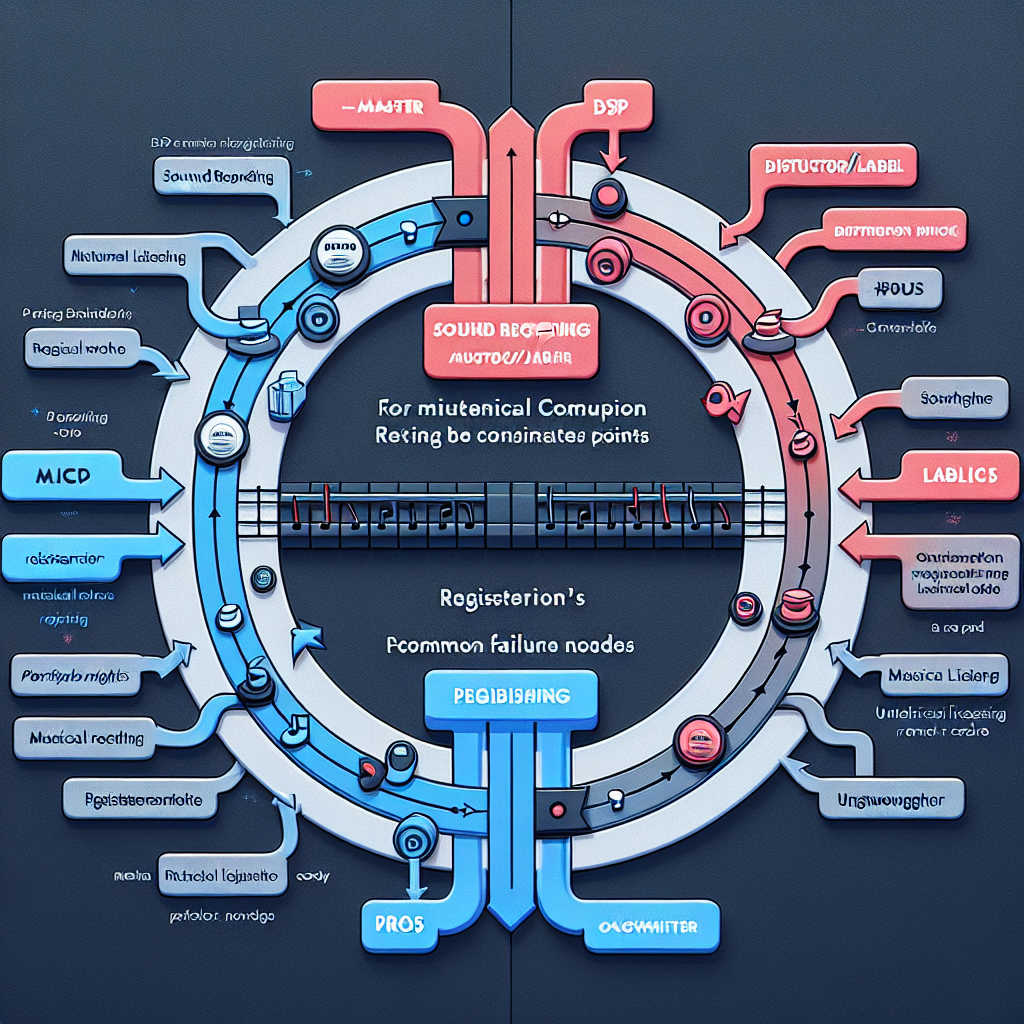
Rights and stakeholders: mastering the master and composition split
TL;DR:
- Two separate revenue chains: DSPs pay for the sound recording (master) and the musical composition (publishing) through different channels and payees.
- Different stakeholders collect each chain: labels or distributors control master receipts; publishers and songwriters control composition receipts via PROs and mechanical agents.
- Registration and metadata matter more than per-stream math: unregistered recordings or compositions produce unallocated funds that rarely find the rightsholder without active claims.
Direct answer: The sound recording and the composition are distinct assets with distinct payees and collection paths. Payments for the master flow from DSPs to the master rights holder and then to any distributor or artist split; payments for the composition move to publishers and songwriters via performance rights organizations and mechanical collection agencies.
Both chains must be treated separately for end-to-end reconciliation. Missing registration, wrong splits, or payment routing errors in either chain create durable leakage that no per-stream estimate will recover later.
Key facts
- Master (sound recording): Owned by label, distributor, or independent artist; DSPs remit this revenue to the recorded-music rightsholder.
- Composition (publishing): Owned by songwriters and publishers; performance and mechanical rights are collected separately and distributed on different schedules.
- Separate registrations required: Register recordings with the applicable master collector and compositions with PROs and the Mechanical Licensing Collective to receive full payment.
- Common failure mode: correct ISRC/ISWC and declared splits are the simplest preventable cause of lost income.
How the two chains operate in practice
Flow difference: The master chain is operationally a single payment route from DSP to the recording rightsholder, often routed through a distributor or label. The composition chain fragments: performance societies, mechanical licensing bodies, and direct publisher licenses each collect and distribute separately.
Practical insight: In real world reconciliations, the composition chain is where most timing and matching problems occur because multiple organizations handle different royalty types and use different identifiers. That multiplies the risk of unallocated revenue when metadata disagrees.
Concrete example: An independent artist uploads a release through a distributor and also self-publishes. If the release has correct ISRCs and the writer registers the work with a PRO and the Mechanical Licensing Collective, the artist will see master receipts through the distributor and publishing receipts via the PRO and MLC. If the songwriter fails to register or declares wrong splits, the publishing income ends up as unallocated and requires manual claims to recover.
Register recordings and compositions separately and verify ISRC/ISWC and split percentages before release to avoid irreversible revenue leakage.
Key takeaway: The same stream generates two bookkeeping problems. Fixing metadata and registration closes more real dollars than chasing marginal per-stream rate improvements.
Practical trade-offs and priority actions
Priority one: Confirm who owns the master and who controls publishing before signing any distribution or label agreement. Ownership determines which party collects first and which downstream deductions apply.
Trade-off to accept: Accept limited opacity from some distribution deals in exchange for marketing and playlist access only if the expected incremental streams exceed likely additional deductions. For rights clarity and modeling, prefer agreements that provide detailed statements and accessible reporting.
FAQ
- Who gets paid first from a DSP? The master rightsholder receives the recording payment; the composition payment is routed separately to publishers and songwriters.
- Can I collect both sides as an independent artist? Yes, if you control both the master and the publishing and complete the required registrations with master collectors, PROs, and the mechanical licensing body.
- What causes unallocated publishing income? Missing or mismatched metadata, unregistered writers, and inconsistent split declarations between platforms and societies.
- Is registering enough to guarantee correct payments? Registration is necessary but not sufficient; accurate metadata, timely reporting by distributors, and matching procedures at collecting societies are also required.
Sources
- IFPI Global Music Report
- SoundExchange distribution rules and payee guides
- The Mechanical Licensing Collective FAQ
- DDEX specifications
- ASCAP distribution and royalty information
Types of royalties relevant to distribution and who pays them
Clear point: Recording-related payments and song-related payments come from different payers and travel on different operational rails — treat them as separate income streams when modeling distribution receipts.
Who pays, who collects — a practical map
Practical insight: Distribution agreements frequently only handle the recording-side flow and administrative uploads to DSPs. Publishing-side collection — registering writers with PROs, filing mechanical splits with the MLC, and claiming neighboring rights — is a separate operational task that many distributors do not complete automatically.
Trade-off to consider: Accepting a distributor that promises easy uploads in exchange for limited publishing services can be convenient but creates collection gaps. If publishing registration is incomplete, composition income will sit in unallocated pools and require manual claims to retrieve — a slow, resource-intensive process.
Concrete example: A mid-size indie label licenses a song into a TV show. The licensee pays a sync fee to the label (master) and a separate fee to the publisher (composition). The label receives its share immediately, but the publisher must account for splits and writer shares before paying songwriters — delays and admin work commonly push songwriter receipts weeks or months after the label gets paid.
Key technical point: accurate ISRCs, ISWCs, and declared writer splits are the single most actionable control for preventing unallocated composition and mechanical income. See the metadata best practices for implementation details.
Operational limitation: Don't assume a distributor's reporting equals collection. Reporting shows activity; recovery of publishing and neighboring rights still depends on registrations with PROs, the MLC, and local societies.
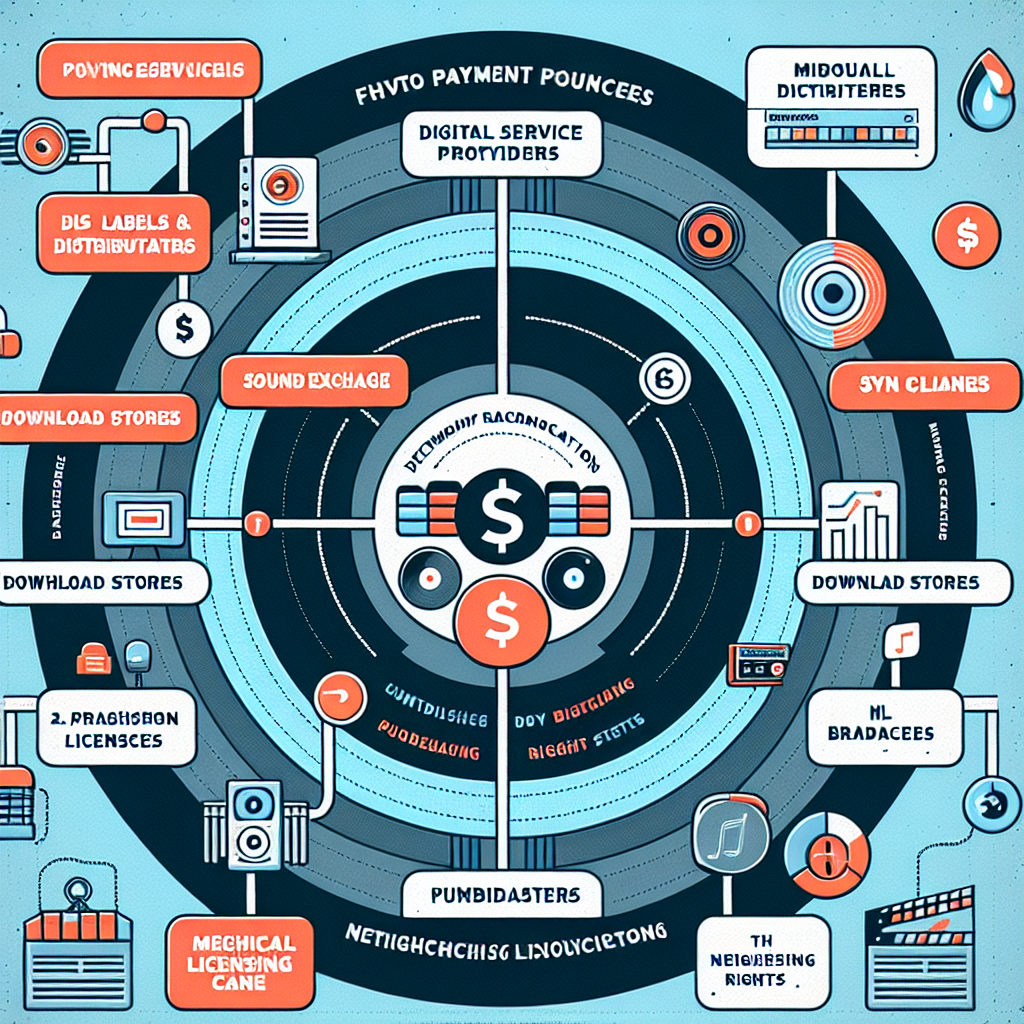
Judgment: For realistic income projections, treat streaming master receipts as the baseline and model composition, mechanicals, neighboring rights, and sync as conditional add-ons. Each add-on requires explicit registration or negotiation; failing to budget for that admin work is the most common source of permanent revenue loss.
Next consideration: verify in writing which collectors your distributor will register with and which publishing services (if any) they will perform. If the distributor does not manage publishing registrations, plan for parallel publisher-side onboarding to avoid missing mechanical and performance collections. For MLC specifics, consult the MLC FAQ.
How DSP economics translate to per stream payouts
Concrete point: A single per-stream figure is the final node of a multi-step pool and weighting calculation — it is not an intrinsic price per play. DSPs first form a net distributable revenue pool, apply weighting and territory adjustments, then divide that pool by a weighted stream count to produce the headline per-stream rate used in statements.
The basic formula and what moves the needle
Formula: per-stream = net distributable revenue / total weighted streams. Net distributable revenue is gross platform receipts after VAT, platform costs, partner commissions, and local taxes. Total weighted streams adjusts raw plays by class (premium vs ad-supported), territory multipliers, and any user-centric weighting applied by the DSP.
Key levers: Changes to any input — the platform revenue mix (premium/ad), country mix, promotional credits, or shifts to user-centric accounting — move the per-stream rate more than small metadata fixes do. Modeling work that ignores weighting and net adjustments misestimates payouts by multiples.
Worked example (master-side calculation)
Concrete example: Assume a DSP reports net distributable revenue for a month of $250,000 and declares 62,500,000 weighted streams. Per-stream = $250,000 / 62,500,000 = $0.004. For 100,000 streams that month the master-side gross receipt is $400 before distributor and label deductions; those downstream deductions determine what the artist actually receives.
- Practical insight: Weighted streams matter — 1 premium stream typically counts for more in the denominator logic than 1 ad-supported stream; a shift of 10 percent of listeners from premium to ad can reduce the per-stream rate materially.
- Limitation: DSP statements often show the headline rate but not the intermediate adjustments that produced it. For reconciliations, you need the DSP breakdown or to reconstruct weights from reported revenue by stream-class and territory.
- Trade-off: Modeling by a single blended per-stream simplifies forecasting but hides exposure to month-to-month volatility. Build scenarios with at least three weight/region mixes (optimistic, base, conservative).
Judgment: Benchmarks like a single cents-per-stream figure are useful only for high-level intuition. When accuracy matters — budgeting advances, projecting recoupment, or validating statements — base models on net distributable revenue and explicit weighting, not on a flat per-stream constant.
Key takeaway: Use net distributable revenue and weighted stream counts as the foundation for per-stream calculations. Always layer distributor and label/contract deductions on top of the per-stream result to estimate artist takehome.
Concrete application: When preparing a royalty model, first collect DSP monthly nets by territory and stream class (premium/ad). Then compute the per-stream from those nets and run the waterfall using your distributor fee schedule and any label royalty terms. This produces realistic cash flows and shows how many streams are required to clear advances or recoup costs.
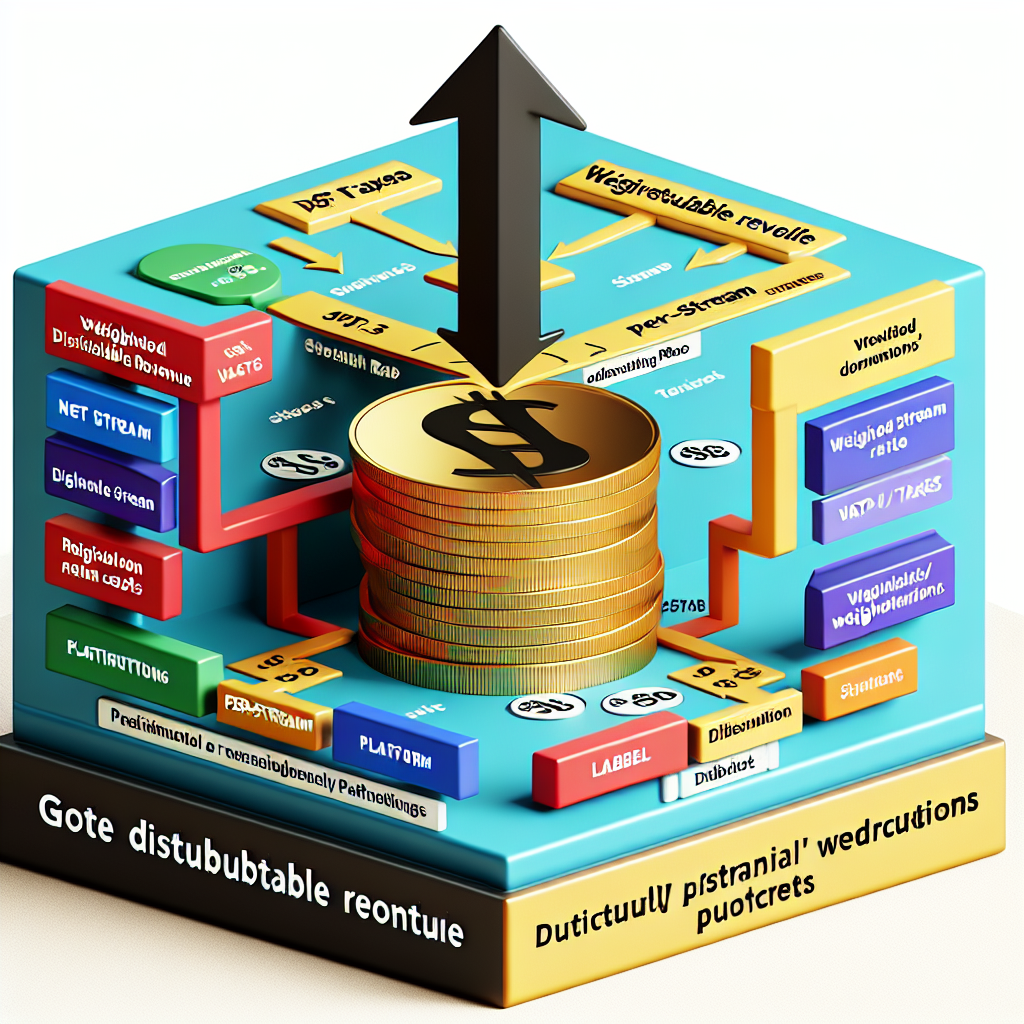
For implementation details and reported DSP breakdown examples, consult the DDEX specifications on reporting and the UniteSync DSP payouts guide. Next consideration: require detailed DSP breakdowns in distributor contracts or plan to reconstruct them from monthly reports to avoid blind spots in reconciliation.
Distributor and label deductions: who takes what before artists are paid
Concrete point: Master-side revenue rarely flows intact from DSP to performing artist. Distributor commissions, currency and tax withholdings, label royalty splits, and recoupable costs together determine the cash the artist actually receives.
Distributor agreements and label contracts create two distinct kinds of deductions - nonrecoupable service fees and recoupable label costs. Model both types explicitly because they behave differently in statements and produce very different cashflow profiles for the same DSP receipts.
Deduction waterfall - step by step
- DSP remits gross master receipts: The platform pays the recording rightsholder or appointed distributor - this is the number that starts the waterfall.
- Distributor deduction and service charges: Common models are percentage commission, per-release fees, or subscription. Example ranges: aggregator commission around 5 to 15 percent, flat-subscription models give the artist full receipts after platform fees.
- Currency conversion, VAT, and withholding: Platforms and aggregators may remove VAT, retain reserves to cover chargebacks, or apply withholding tax for cross-border payments - these are subtractions before any label accounting.
- Label receipt and internal deductions: If a label controls the master, it receives distributor net and then applies the artist royalty band, reserves, and recoupable expenses such as advances, recording costs, and marketing charges.
- Artist pay and timing: After the label clears recoupment and applies its royalty rate, it issues payments to the artist according to contract cadence. If recoupable balances remain, artist payments can be zero despite active streaming.
Practical insight: Distributor fees are visible and predictable; label recoupment is opaque and often the largest source of long term artist income suppression. When modeling, treat distributor commission as a simple multiplicative factor and label recoupment as a conditional floor that can block artist receipts for long periods.
Concrete example: A DSP sends a distributor a $1,200 master payment for a month. If the distributor takes 9 percent, $108 is retained and $1,092 is forwarded to the label or self releasing artist. If the artist is on a label deal that pays a 20 percent artist royalty on net but the label has a recoupable advance of $8,000, the label will report the artist earned $218.40 that month but apply it to recoupment, so no cash is paid to the artist until the advance is cleared. By contrast a direct distribution subscription model would deliver the full post-platform net to the artist at the distributor level, increasing short term cashflow but without label services.
Limitation and tradeoff: Choosing a distribution path is a tradeoff between transparency and service. Self distribution gives predictable, near real-time cash receipts but limited marketing leverage. Label deals can increase gross streams but the label accounting, reserves, and recoupable costs frequently eliminate artist payouts for months or years. Assume label support needs to produce materially higher streams to justify the revenue drag.
Operational requirement: Before signing, require contract clauses or an appendix that specifies exact waterfall steps: gross DSP amount, distributor fee percentage or schedule, reserve policy, foreign exchange costs, label royalty band, allowed recoupable items, and statement frequency. Use these line items to run a five year cashflow sensitivity analysis.
Practical checks to avoid surprise deductions
- Confirm which payments the distributor will remit versus hold for the label: Some distributors act as pass throughs only, others aggregate and net across catalogs.
- Get a list of allowed recoupable expenses and audit rights in writing: Vague contract language is the most common reason artists cannot recover withheld sums.
- Require monthly line item statements: Statements should show gross platform receipts by territory and stream class, distributor deductions, currency conversions, and label application of receipts so you can reconcile on a net and gross basis.
For technical reconciliation, require DDEX style reporting or equivalent CSV exports from the distributor to reconstruct the waterfall. See the UniteSync DSP payouts guide at UniteSync DSP payouts guide for recommended fields to request.
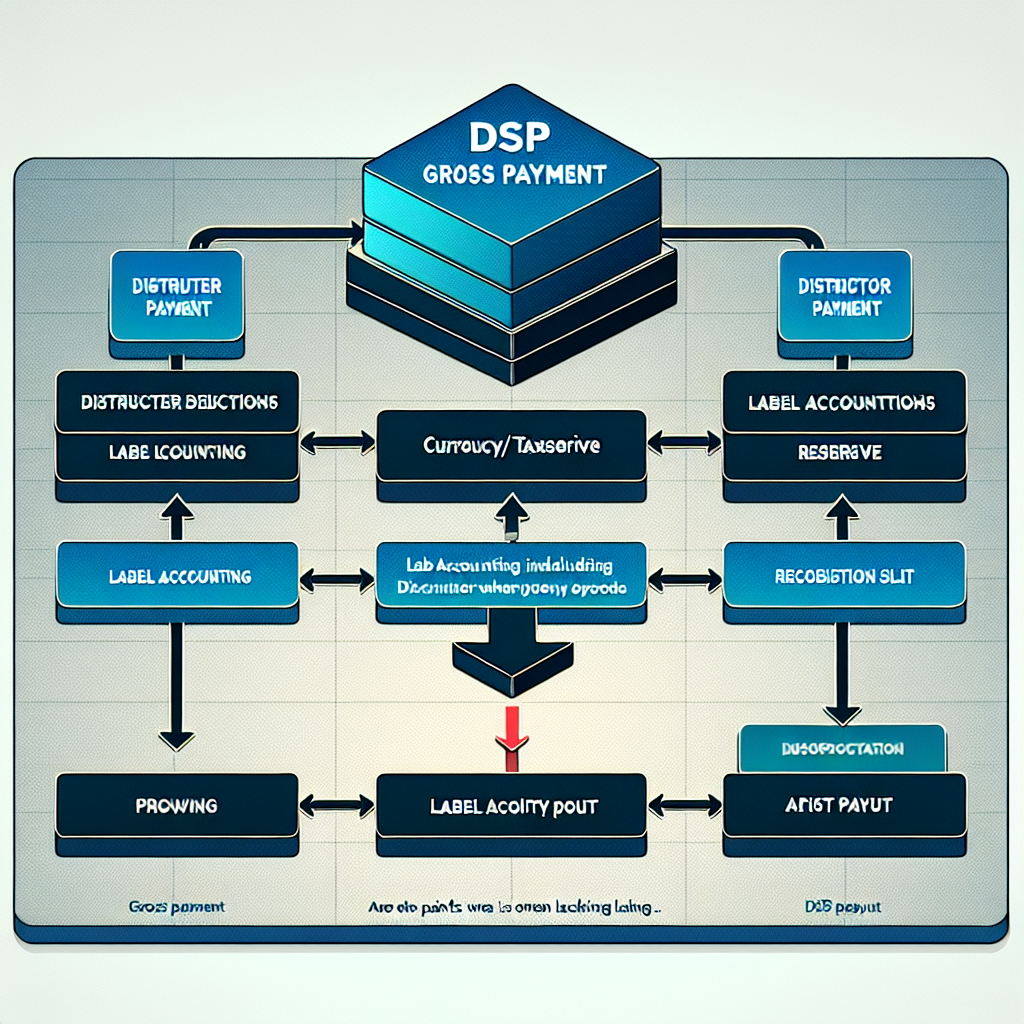
Next consideration: Run two small experiments before committing - request a sample monthly statement for a comparable release and model the waterfall under a conservative streaming scenario. If the distributor or label will not provide that visibility, treat expected incremental reach as speculative.
Worked examples: convert streams into realistic earnings
Direct assertion: A reported stream count only becomes meaningful after you pick a net-per-stream assumption, split that revenue between master and composition, and run the distributor/label waterfall. Small changes to any input produce large differences in artist cashflow.
Assumptions used in these worked scenarios
Model assumptions (for all scenarios): 100,000 total streams with a platform mix of 60% Spotify, 25% Apple Music, 15% YouTube; platform net-per-streams assumed at Spotify $0.0035, Apple $0.0080, YouTube $0.0008. Use a master/composition split of 70/30 on gross streaming receipts. These are illustrative assumptions — change any input and results move materially.Walk-through math (Scenario 1): Spotify 60k $0.0035 = $210; Apple 25k $0.0080 = $200; YouTube 15k * $0.0008 = $12; total = $422. Master = 70% = $295.40; Composition = 30% = $126.60. If the artist owns both sides and collects publishing, total cash ≈ $422 before tax/withholding.
Walk-through math (Scenario 2): Master $295.40 − distributor 15% ($44.31) = $251.09 to label. Artist royalty = 50% * $251.09 = $125.55, but applied to a $10,000 recoupable advance so no cash payout until recoup cleared. Composition $126.60 flows to songwriter (separate collection path).
Walk-through math (Scenario 3): Master per-stream (blended) = $295.40 / 100,000 = $0.002954 per stream. Artist royalty = 15% * $0.002954 = $0.0004431 per stream. Streams required to generate $50,000 in artist-royalty credit = 50,000 / 0.0004431 ≈ 112,800,000 streams. That is the scale needed before artist begins to see royalty checks on the major-deal master-side (composition still separate).
Practical insight and trade-off: Self-distribution delivers faster, predictable cash at small scale because there are fewer recoupable steps; label deals shift risk to the label and require very large audience increases to overcome recoupment and low royalty bands. Composition income often remains the most immediate cash for signed artists because publishers and PRO payments are usually treated separately from label recoupment.
Concrete use case: An independent singer-songwriter hits 100,000 streams and self-publishes: they can expect roughly $420 gross that month across master and publishing under these assumptions. The same performance on a 50% royalty indie label with a $10k advance yields only the composition share as immediate cash — the master-side earnings go to recoup the advance.
Key takeaway: When modeling, treat composition receipts as operationally independent from master receipts. Use conservative net-per-stream inputs and run a recoupment scenario — label advances change when cash reaches the artist far more than small percentage differences in per-stream rates.
Judgment: For most independent acts the practical goal is to maximize early collectible composition registrations and remove unnecessary distributor commissions. Label deals are only worth the trade if they reliably deliver an order-of-magnitude increase in streams; otherwise, the recoupment mechanics and lower royalty bands will delay or eliminate artist cash despite high headline stream counts. See the UniteSync DSP payouts guide for building the net-per-stream inputs used in these models.
Metadata registration and the mechanics of collection
Direct point: Metadata and registration are the operational switches that route money — if the identifiers and split files do not match the collector records, the revenue becomes unallocated and stays there until you actively claim it.
How registration actually moves money
Practical workflow: A DSP reports usage containing the release identifiers it received from the distributor; collectors (PROs, MLC, SoundExchange, neighboring-rights societies) match that report to their registered records using ISRC, ISWC, contributor IPI numbers, and declared splits. Successful matches trigger automated distributions; any mismatch sends the money to an unallocated pool that requires manual matching and proof to recover.
- Essential registration steps: Assign and lock ISRCs on every master; register each composition with a PRO and with the Mechanical Licensing Collective (US) or the local mechanical agent; submit accurate writer and publisher IPI numbers and percentage splits before release.
- Distributor-to-DSP delivery: Push complete DDEX-compliant release messages (including contributor roles and
Resource/SoundRecordingmappings) so DSPs and collectors see identical metadata. - Post-release monitoring: Reconcile distributor reports to PRO/MLC/SoundExchange dashboards monthly and track unmatched usages for claims.
Trade-off to accept: Automating registration through an aggregator saves time but often omits composition registrations or publishes incomplete splits. Doing publisher-side onboarding yourself increases admin but materially reduces unclaimed mechanical and performance income.
Common matching failures and their fixes
- Incorrect or missing ISWC: Composition income appears in unallocated pools; fix by submitting a corrected ISWC and signed split sheet to the PRO/MLC.
- Name variants and authority mismatches: Multiple artist name spellings fragment matches; consolidate names with a canonical performer string and map aliases in the distributor metadata.
- Split file disagreements: When distributors and publishers submit different writer percentages, societies hold funds pending resolution; use a signed, timestamped split agreement to accelerate a claim.
Concrete example: A songwriter used a stage name on the release but registered their IPI under a legal name. Streams were reported by the DSP using the stage name and the composition income entered the MLC unmatched pool. By submitting the signed split sheet and confirming the IPI link with the PRO, the songwriter recovered two quarters of withheld mechanicals — the process took three months and required explicit proof of authorship.
Key control: treat metadata as a versioned, auditable dataset. Keep the original split sheet, ISRC/ISWC logs, and DDEX manifests together so a claim can be processed quickly.
Operational consequence: Missing or inconsistent metadata is recoverable but costly. Expect claim windows, manual reviews, and multi-month delays; prioritize front-loading accurate registration rather than retroactive fixes.
Practical checklist before pressing distribute: Verify ISRCs and ISWCs, confirm writer IPI numbers and publisher account IDs, publish a signed split sheet to all co-writers, and push a full DDEX release message to the distributor. Then monitor PRO/MLC/SoundExchange dashboards and reconcile within 30 days of release.
Judgment: Do not assume distribution equals collection. For real revenue recovery, own the composition registration and maintain authoritative split documentation. This is where modest upfront administrative effort converts directly into dollars received, faster and with far less friction than chasing small per-stream rate improvements.
Modeling, monitoring, and next steps for rights holders
TL;DR: Build a reproducible model from DSP net revenue to payee receipts, reconcile it monthly against distributor and collection dashboards, and treat metadata and contract terms as the two controls that move the largest amounts of money.
Direct answer: Effective royalty management is a three-part operation: (1) a transparent numeric model that converts reported streams into cash at each accounting node, (2) an active monitoring cadence that finds mismatches quickly, and (3) a prioritized remediation workflow to recover unallocated sums and fix upstream causes. Rights holders who skip any one of these steps will routinely undercount collectible income.
Modeling: build the smallest accurate model that answers the question you have
Start with outcomes: Decide whether you need to forecast artist cash, recoupment timing, or publishing receipts. Each outcome requires different fidelity of inputs and a different error tolerance.
Minimum inputs: Collect monthly net receipts by DSP and territory, stream counts split by class (paid/ad-supported), contract waterfall terms, and the precise publishing split schedule. Do not rely on headline cents-per-stream benchmarks for any contract-sensitive calculation.
Model design tip: Use a layered spreadsheet or light script: layer 1 converts net DSP revenue to gross master and composition buckets; layer 2 applies distributor/label deductions and recoupment rules; layer 3 projects payment timing after reserves and withholding. Keep the model parameterized so you can run three scenarios quickly: base, conservative, and upside.
Monitoring routine: what to check and when
- Daily/weekly: ingestion checks — verify distributor delivery files arrived and DDEX manifests processed without error.
- Monthly: reconcile the model to the distributor statement and the collection dashboards (SoundExchange, PROs, the MLC). Flag line items that do not match within tolerance.
- Quarterly: audit sample releases end-to-end — compare DSP reported streams, distributor remits, and eventual society payouts; escalate discrepancies over a threshold for formal claims.
- Annual: request a rights audit clause exercise if material unreconciled income exceeds your threshold.
Practical insight: Early detection matters. A small metadata mismatch left unattended compounds into larger, harder-to-prove gaps as releases age. Fixes are cheaper when they are recent; older claims require more documentation and often hit limitation windows.
Next steps and operational checklist for rights holders
- Instrument the model: ingest one month of distributor CSV or DDEX export and run the waterfall to produce expected payee amounts.
- Assign ownership: pick a single person accountable for uploads, registrations, and monthly reconciliation; make that role the claim owner when mismatches appear.
- Prioritize fixes: recoverable items should be triaged by ease-of-recovery and dollar value — metadata corrections and split-sheet submissions are high ROI and fast wins.
- Lock audit rights and statement detail in contracts: require itemized remits and a machine-readable export format to automate reconciliation.
Limitation and trade-off: High-fidelity modeling requires more data and maintenance. If resources are constrained, focus on accurate publishing registration and a single monthly reconciliation pass; this captures the majority of recoverable leakage without expending engineering resources on full automation.
Concrete example: A rights administrator built a three-sheet model that ingested one month of distributed DDEX exports, applied the catalog-level distributor commission and label royalty band, and projected recoupment burn-down for a recent advance. The model showed the artist would not clear recoupment for multiple years under current streams; armed with that projection the team renegotiated reserve timing and obtained more detailed monthly statements, which accelerated cash visibility and reduced months of uncertainty.
Key action: Make registrations, split agreements, and an automated reconciliation file the first three line items on your operational plan. Everything else is optimization.
Judgment: Rights holders who prioritize clean inputs and repeatable checks recover more money than those who chase marginal per-stream rate improvements. Focus effort where it scales: standardized exports, clear contract waterfalls, and an enforced reconciliation cadence.
Next consideration: after you automate the monthly reconciliation, convert recurring exceptions into contractual changes or operational fixes so the same problem does not recur.
Frequently Asked Questions
Direct point: This FAQ gives concise, operational answers to the recurring reconciliation and collection questions practitioners face when modeling music distribution royalties explained. The emphasis is on what to check, what fails in practice, and what to do next.
Short definition: Music distribution royalties flow through separate operational rails for the sound recording and the composition. Getting paid requires correct identifiers, timely registrations, and visibility into the contractual waterfall that sits between DSP remits and the final payee.
Quick answers
Who receives the recording payment first? The service pays the master rightsholder or their distributor; that entity then applies its commission and any label accounting before forwarding artist amounts.
How are composition payouts collected? Performance societies and mechanical collection bodies handle composition money separately; those collections depend on registrations and submitted split information rather than distributor remits.
Can an independent artist collect everything? Yes, if the artist controls both master and publishing and completes registrations with the relevant collectors. Failing to register creates unallocated pools that require manual claims.
Why do my statements not match reported streams? Reporting differences arise from DSP-level weighting, regional nets, currency/tax deductions, and delayed or aggregated remits by distributors — you must reconcile net receipts rather than raw stream counts.
When do recoupable advances block payments? Advances and allowed recoupable charges are applied at the label accounting stage; until the recoupment ledger clears, artist cashflow from master receipts can be zero despite ongoing streaming.
Who to contact when money is missing? Start with your distributor for master-side issues and with your PRO/MLC for composition or mechanical shortfalls. Provide ISRC/ISWC, signed split sheets, and DDEX manifests to accelerate matching.
Operational note: Missing or inconsistent split files are the single most frequent cause of delayed publishing payments. Keep a versioned split agreement and the original DDEX release manifest ready for claims.
Concrete example: An independent songwriter discovered composition income in the MLC unmatched pool after release because the ISWC was omitted by the distributor. After submitting the signed split sheet and confirming the writer IPI with the PRO, the MLC matched the usages and released backlog payments across the next two distribution cycles — the recovery required direct documentation and took multiple weeks.
Practical trade-offs and limitations
Trade-off: Outsourcing publishing registration saves time but often omits full split administration; doing publisher-side onboarding increases admin but reduces long-term leakage. Choose based on catalog scale and your tolerance for manual claims.
Limitation: Cross-border neighboring-rights and local society rules create territory-specific gaps that rarely auto-correct. Expect additional registration work outside the US and separate claims processes.
Actionable next steps
- Pull one month of distributor exports and map each ISRC to the composition ISWC and registered writer IPI — flag mismatches for immediate correction.
- File missing registrations with your PRO and the Mechanical Licensing Collective; attach signed split sheets and timestamped manifests when submitting claims. See the MLC FAQ for required documents.
- Demand machine-readable statements (DDEX or CSV) and a clear contract appendix that lists distributor fees, reserve policies, and allowed recoupable items; use those fields to parameterize your model.
- Assign an owner who runs a monthly reconciliation and opens claims within the early detection window to minimize documentation friction.
Final takeaway: For concrete improvements in collected revenue, prioritize registrations, authoritative split documentation, and contract-level visibility into the waterfall. Those three actions deliver more recovered cash than chasing small per-stream optimizations.